Check Engine Light Flashing: Can I Still Drive?
You are merging onto the highway, the car starts to shudder, and the amber light on the dash is not just on — it is blinking. Your first search is the right one: check engine light flashing, can I still drive? The short answer is no, not like this. A flashing light means pull over safely and stop guessing. A steady light is a different conversation. Mixing the two up is how a fixable misfire turns into a much larger bill.
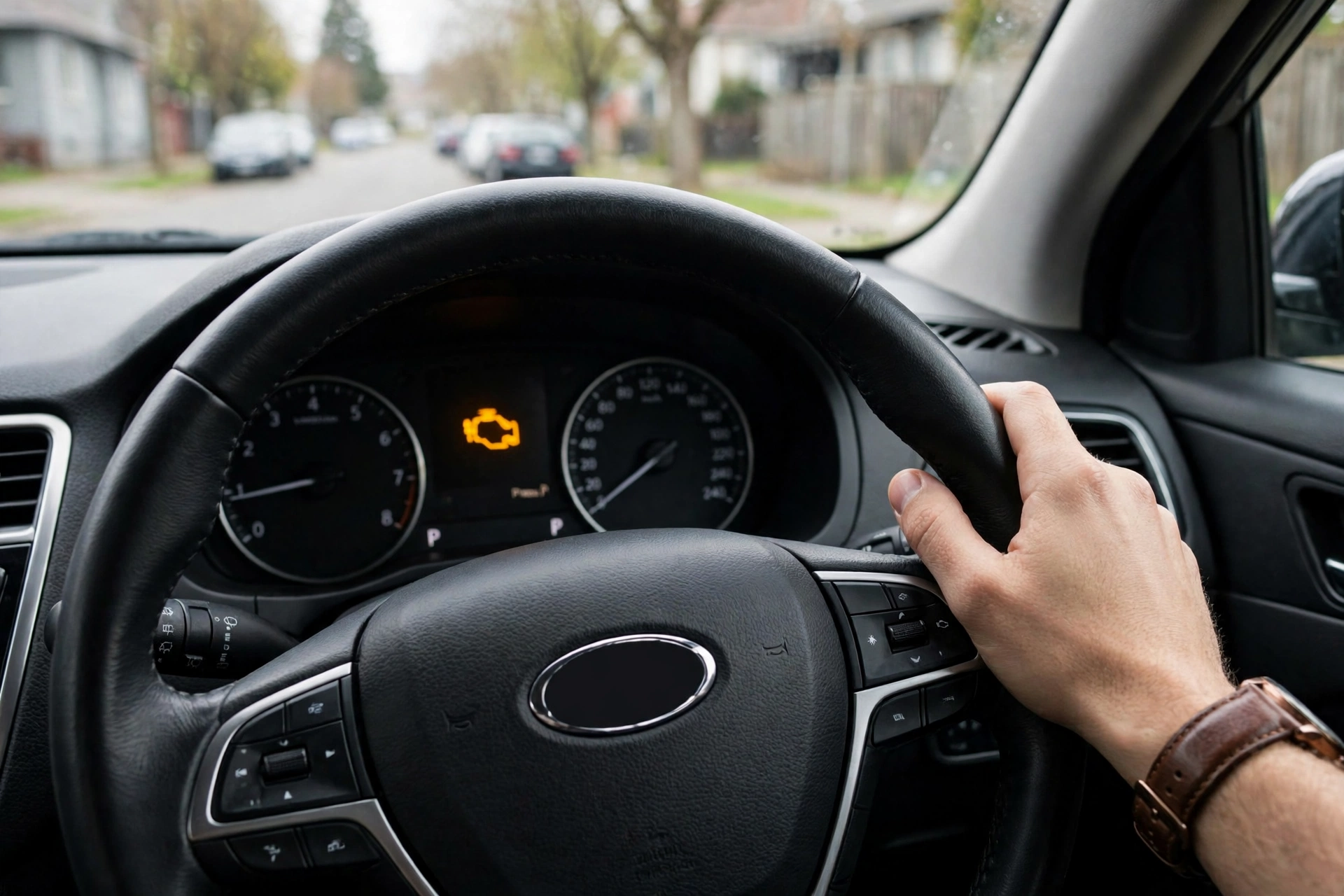
Flashing vs. steady: what the light is telling you
A steady check engine light means the engine computer has stored a fault and wants it checked soon. Drive gently, avoid hard acceleration, and get the code read promptly — but it is usually not a pull-over-this-minute emergency on its own.
A flashing light means something is actively going wrong right now, most commonly an engine misfire: one or more cylinders are not firing properly, so unburned fuel passes through the engine. Keep driving in that state and that fuel can overheat and damage the catalytic converter. On AI Mechanic's own P0300 guide, that converter damage is put at $1,000 or more — on top of the original fault. That is why the guidance for a flashing light is consistent: pull over safely and stop driving.
Pay attention to what you feel, not just what you see. Shaking, rough idle, loss of power, or a change in engine sound alongside a flashing light all point the same way. And a light alone does not name the part — owners who replace the first part a forum mentions often pay twice.
Why a flashing light usually means a misfire
When several cylinders misfire, the computer often stores code P0300 — random or multiple cylinder misfire detected. A single-cylinder code such as P0301 points at one cylinder. P0300 is broader, which is why the checks need to be ordered, not random.
AI Mechanic ranks the most likely causes for P0300 in this order:
- Worn spark plugs. Listed as the most common cause. Plugs wear out every 30,000 to 100,000 miles depending on type.
- A failing ignition coil. Coils crack with heat and age, and one failing coil can trigger misfires across cylinders.
- A clogged or failing fuel injector. Restricted fuel delivery starves one or more cylinders.
- A vacuum leak. Extra, unmetered air leans out the mixture across cylinders.
- Low fuel pressure. A weak pump or clogged filter starves the engine overall.
Start with the common, confirmable causes first. When were the plugs last changed? Does the shaking change under load? Those details change which cause rises to the top for your car.
Check engine light flashing can I still drive — how AI Mechanic helps you decide
AI Mechanic is built for this parked-in-a-lot moment. You do not need a scanner in the glove box or a shop's vocabulary to get a useful first read.
Start on the diagnose page: describe the symptom in plain words ("shaking at idle, light flashing, worse when I accelerate"), describe a noise in text, or enter an OBD-II code by hand if you have one — for example, P0300 or P0420. With a free account, you can add a photo too.
It returns ranked possible causes with the evidence for each and the confirmation checks that usually come first, explained in plain English for your specific vehicle. It also gives estimated repair costs and a do-it-yourself versus shop comparison, so you see the shape of the bill before anyone quotes you. Follow-up chat knows your vehicle, so you can ask what to have the shop check first without starting over.
It does not replace a mechanic or a professional inspection — the site says so directly. What it replaces is the blank panic between the light coming on and the shop opening: you arrive with a code explained, causes in order, and questions that make the quote easier to judge.
Pricing is stated on the site: the free plan includes 200 tokens each month — about 40 text questions or about 13 photo analyses — with no card required. Paid plans start with DIY at $4.99 a month, with a 7-day free trial. Details are on the pricing page.
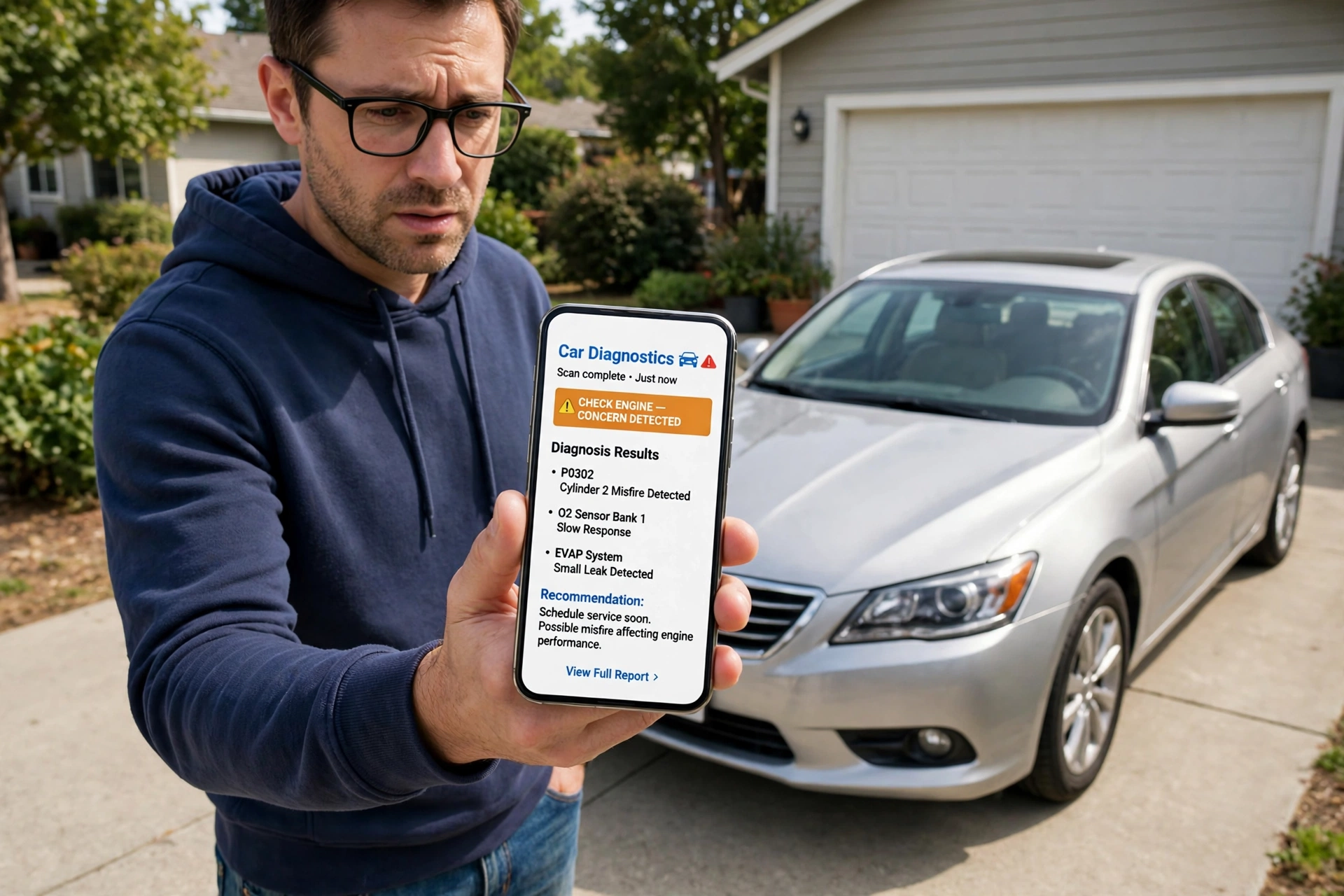
Example: from flashing light to an ordered checklist
Here is a worked example — an illustration, not a real customer case.
Imagine a sedan owner whose car shudders at a red light. The light starts flashing, idle is rough, and power feels flat. She pulls into a parking lot, turns the engine off, and opens AI Mechanic on her phone.
She describes the symptom and adds that a free code read gave her P0300. The result explains that P0300 means random or multiple cylinders are misfiring, ranks worn spark plugs first, then coils, injectors, a vacuum leak, and low fuel pressure, and lays out the confirmation checks that usually come first. It gives the range the site publishes for P0300 — typically $100 to $600, with plugs typically $100 to $300 and coils typically $150 to $400, noting estimates vary by vehicle, location, and shop.
Instead of driving home and hoping, she can now say at the shop: "It stored P0300, it shakes at idle — please check plug and coil health before you quote a converter." The value is not a magic answer. It is arriving informed, with the urgent decision — stop driving — already made correctly.
Who this is for — and who it is not for
This is for owners who want to understand a symptom, photo, described noise, or code before they spend money — and for anyone who keeps a digital garage, since AI Mechanic also saves service history, tracks maintenance, and saves free NHTSA VIN specifications and model-level recall checks.
It is not for an emergency where the car is unsafe — overheating, heavy smoke, or loss of steering or braking. Stop and call for help. It is also not a substitute for a professional inspection when buying a car or handling a safety recall.
Frequently asked questions
If the check engine light is flashing, can I drive a short distance?
The site's guidance for P0300 is to pull over safely — continued driving risks serious damage. If you must move the car, keep it minimal, gentle, and direct to a safe place or a shop. When in doubt, a tow is cheaper than a converter.
What if the light was flashing and then went steady?
A reprieve, not a clearance. A misfire that comes and goes still stores a fault and needs the code read promptly. Note when it flashes — at idle, under load, when cold — because that pattern helps rank the causes.
How much does it cost to fix a flashing check engine light?
There is no single price, because the light is a warning, not a part. For P0300, AI Mechanic lists typically $100 to $600, with plugs typically $100 to $300 and coils typically $150 to $400. Estimates vary by vehicle, location, and shop, and driving on a flashing light can add converter damage of $1,000 or more.
Do I need my own OBD-II scanner to use AI Mechanic?
No. Start from a described symptom, a described noise, or a photo. If you do have a code, enter it by hand and get what it means on your specific engine, the possible causes, and the checks that usually come first.
Is AI Mechanic free to try for this?
Yes. The free plan includes 200 tokens each month — about 40 text questions or about 13 photo analyses — with no card required.
Do not drive on a flashing light — get the first read now
If your check engine light is flashing, pull over safely first. Then get the code and the symptom explained in plain English, with likely causes ranked and a cost range to compare against any quote.
Start free on the diagnose page — describe what the car is doing or enter a code, and see what to check first. With a free account, you can add a photo as well. If you want the full plan details, compare them on pricing.